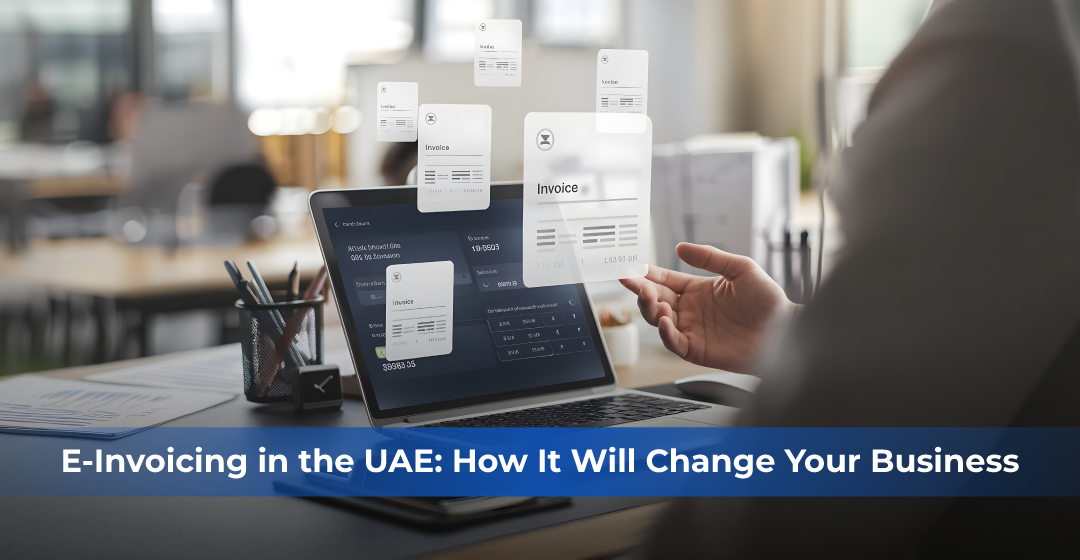






If your business operates in the UAE, a major shift is coming to how you send and receive invoices. E-invoicing in the UAE is no longer a future consideration. It is an active regulatory requirement with a clear timeline, phased deadlines, and penalties for non-compliance. Whether you run a large enterprise or a small business, this change will affect your operations directly.
This guide explains what e-invoicing in the UAE means, how it will be implemented, what the regulations require, and what it means for your business.
What Is E-Invoicing in the UAE?
E-invoicing in the UAE refers to the electronic creation, exchange, and storage of invoices in a structured digital format under the government’s Electronic Invoicing System (EIS). Unlike sending a PDF or a scanned document by email, e-invoices are generated in a machine-readable XML format and transmitted through government-approved channels.
This initiative is part of the UAE’s broader drive to digitize its tax administration, strengthen VAT compliance, and align with global best practices. It builds on the UAE tax framework already in place and introduces a new layer of real-time reporting between businesses and the Federal Tax Authority (FTA).
The E-Invoicing Framework: How It Works
The e-invoicing regulations are governed by the Ministry of Finance (MoF), which sets out the UAE e-invoicing guidelines, technical standards, and implementation timeline for all businesses in the UAE. The mandatory data format is PINT-AE, requiring every invoice to be structured in XML and contain mandatory fields including supplier and buyer details, tax identification numbers, VAT breakdowns, and invoice amounts.
The UAE has adopted a Peppol-based 5-corner Decentralized Continuous Transaction Control and Exchange (DCTCE) model. In this framework, the Accredited Service Provider (ASP) validates the invoice, converts it (if needed) into the required PINT-AE XML format, transmits it to the buyer’s ASP via the Peppol network, and reports the tax data to the Federal Tax Authority (FTA) in parallel (near real-time). The buyer’s ASP then delivers the invoice to the buyer and also reports tax data to the FTA.
Implementation Timeline: Key Dates to Know
The UAE e-invoicing guidelines set a phased rollout based on business size:
| Phase | Who It Applies To | Key Dates |
|---|---|---|
| Pilot | Selected businesses (MoF-invited) | 1st July 2026 |
| Voluntary | Any business | 1st July 2026 |
| Phase 1 (Large Taxpayers) | Revenue over AED 50 million | ASP by 31st Jul 2026; Mandatory by 1st Jan 2027 |
| Phase 2 (SMEs) | Revenue below AED 50 million | ASP by 31st Mar 2027; Mandatory by 1st Jul 2027 |
| Phase 3 (Government) | Government entities | ASP by 31st Mar 2027; Mandatory by 1st Oct 2027 |
Note: B2C transactions are currently excluded from the mandate. The e-invoicing requirements apply to B2B and B2G transactions only.
How to Implement E-Invoicing in the UAE
Getting ready for e-invoicing in the UAE requires preparation well before your mandatory deadline. Here is what businesses need to do:
1. Assess your current invoicing setup
Review your ERP or accounting software to identify gaps. Check whether your system can generate structured XML invoices in the PINT-AE format.
2. Appoint an Accredited Service Provider (ASP)
Every business must connect to a MoF-approved ASP. This is a core e-invoicing requirement; your ASP validates, converts, and transmits invoices to both your buyer and the FTA simultaneously.
3. Register on EmaraTax
ASP onboarding is completed through the FTA’s EmaraTax portal. Allow 8 to 12 weeks for the process, especially for larger businesses.
4. Map your invoice data
Align your data to the PINT-AE data dictionary. Key e-invoicing requirements include your Tax Identification Number (TIN), VAT amounts, buyer and supplier details, and invoice sequential numbers.
5. Test before going live
Use the voluntary pilot phase from 1 July 2026 to test your systems without penalty exposure. This window is the best time to catch and fix errors.
6. Train your team
Finance teams need to understand the new workflow. Errors cannot be edited after an invoice is reported, and corrections must be made through credit notes.
What This Means for VAT-Registered Businesses
For businesses registered for VAT in UAE, e-invoicing in the UAE changes how tax invoices are issued and reported. Paper invoices and PDFs will no longer be valid for input VAT recovery once your mandatory phase begins. The e-invoicing requirements include issuing all tax invoices and credit notes electronically through a certified ASP, in XML format aligned with the PINT-AE data dictionary, with all mandatory fields including your TRN, VAT amounts, and supply dates.
Meeting the e-invoice criteria also means upgrading your ERP or accounting software and completing ASP onboarding before your applicable deadline. Under the e-invoicing regulations, non-compliance carries penalties of AED 5,000 per month for system failures and AED 100 per non-compliant invoice, capped at AED 5,000 monthly.
How InZone Can Help
E-invoicing in the UAE represents one of the most significant compliance shifts for businesses since the introduction of VAT. The framework, deadlines, and system changes that come with it are not always straightforward.
InZone supports businesses across the UAE through tax compliance, business setup, and regulatory changes. If you need help understanding how the UAE e-invoicing guidelines apply to your business, our professional team is here to support you.











 Founder's Podcast
 Free Zone
 Offshore
 Mainland
 Accounting
 Banks
Banks Services
 Resources