





Table of Contents
- What Are Designated Zones in the UAE?
- How Does a Designated Zone Differ From Other Free Zones?
- Which RAKEZ Zones Are VAT Designated Zones?
- VAT Treatment in RAKEZ Designated Zones
- What Does Designated Zone Status Change for Goods and Services?
- Can a RAKEZ Company Qualify for the 0% Corporate Tax Rate?
- What Does a Non-Qualifying RAKEZ Company Actually Pay?
- What Ongoing Compliance Requirements Apply to RAKEZ Companies?
- Set Up Your RAKEZ Company With the Right Tax Structure
- Frequently Asked Questions
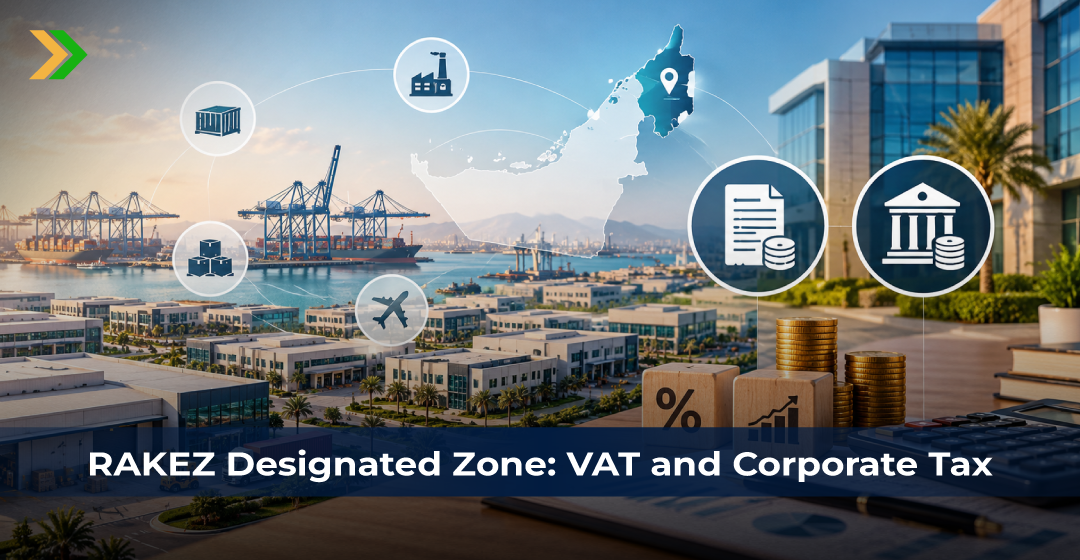
The tax position of a RAKEZ company depends on several factors, including its location, RAKEZ business activity, transactions, and whether it meets the conditions under the UAE VAT and Corporate Tax regimes. The distinction is particularly important because Designated Zone status has a specific meaning for VAT, while the 0% Corporate Tax regime for free zone businesses follows a different set of rules.
This guide explains how RAKEZ VAT registration, VAT treatment, and corporate tax requirements apply to businesses operating in RAKEZ.
What Are Designated Zones in the UAE?
A designated zone in the UAE is a specific, fenced free zone that the Federal Tax Authority (FTA) treats as being outside the UAE territory for Value Added Tax (VAT) purposes regarding the supply of certain goods. While all designated zones are free zones, not all free zones are designated zones.
A Designated Zone must meet specific conditions under UAE VAT legislation, including requirements relating to security, customs controls and the movement of goods. This status can provide special VAT treatment for qualifying goods transactions, but it does not mean that every transaction within the zone is exempt from VAT in the UAE. Services and other transactions remain subject to the applicable VAT rules, which means businesses considering a RAKEZ company formation should assess their specific activities and transactions before determining their RAKEZ VAT obligations.
How Does a Designated Zone Differ From Other Free Zones?
A Designated Zone is not simply another name for a free zone. A UAE free zone is an economic zone established to support specific types of businesses and investment. A Designated Zone is an area that has been recognised for special VAT treatment under the UAE VAT framework.
As a result, not every free zone is a Designated Zone for VAT purposes. The distinction also matters within RAKEZ because the authority operates different areas for industrial, business, academic and other activities. The physical location of a business can therefore affect its VAT position.
| RAKEZ Designated Zone | Effective From | Notes |
|---|---|---|
| RAK Free Trade Zone (RAK Port Free Zone / RAK FTZ) | 1 January 2018 | Core free-trade and port area |
| RAK Maritime City Free Zone | 1 January 2018 | Port and maritime-focused area |
| RAK Airport Free Zone | 1 January 2018 | Airport-related area |
| Al Hamra Industrial Zone – Free Zone | 4 July 2019 | Added under Cabinet Decision No. 43 of 2019 |
| Al Ghail Industrial Zone – Free Zone | 4 July 2019 | Added under Cabinet Decision No. 43 of 2019 |
| Al Hulaila Industrial Zone – Free Zone | 4 July 2019 | Added under Cabinet Decision No. 43 of 2019 |
These are the RAKEZ zones eligible for special VAT treatment on qualifying goods transactions. In effect, certain goods transactions within these zones may be treated as taking place outside the UAE for VAT purposes. However, this treatment is subject to the continued fulfilment of the Article 51 conditions, including fencing, security, Customs controls, internal procedures and operator compliance, as set out in the FTA Designated Zones VAT Guide.
VAT Treatment in RAKEZ Designated Zones
VAT treatment in a RAKEZ Designated Zone depends on the type of transaction and where the goods are moving. Generally, qualifying goods supplied within or between Designated Zones may be outside the scope of UAE VAT when the relevant conditions are met. However, goods moved from a Designated Zone into mainland UAE are generally treated as imports and subject to the applicable VAT rules. Similarly, goods moving from mainland UAE into a Designated Zone are subject to specific rules based on the transaction and applicable conditions.
Services, on the other hand, do not receive the same special treatment as qualifying goods. Therefore, businesses providing consulting, IT, design, or other services remain subject to the applicable UAE VAT rules. In addition, RAKEZ VAT registration follows the general UAE thresholds: mandatory registration applies when taxable supplies and imports exceed AED 375,000, while voluntary registration is available from AED 187,500.
What Does Designated Zone Status Change for Goods and Services?
The main misconception about RAKEZ VAT is that Designated Zone status automatically makes all supplies subject to 0% VAT. This is not the case. Designated Zone status affects the VAT treatment of certain supplies of goods, while services remain subject to the applicable UAE VAT rules.
GOODS:
When the required conditions are met, the following movements of goods may fall outside the scope of UAE VAT:
- Within the same Designated Zone: Supplies of goods may be outside the scope, provided the goods are not consumed or used in a way that brings them into the UAE for VAT purposes.
- Between Designated Zones: Transfers may be outside the scope, subject to the required customs controls and conditions.
However, the special treatment changes when goods move outside the Designated Zone:
- Designated Zone to mainland UAE: Goods are generally treated as imports and subject to the applicable import VAT rules.
- Mainland UAE to Designated Zone: Goods remain subject to the normal domestic VAT rules and are not treated as exports.
- Goods consumed or used within the Designated Zone: The goods may come within the scope of UAE VAT and become subject to the standard 5% VAT rate.
SERVICES:
Services do not receive special VAT treatment solely because they are supplied from a Designated Zone. Accordingly, whether a business provides consulting, design, IT, logistics, management or other services, the standard UAE place-of-supply rules continue to apply. In most cases, this means the supply is treated as taking place in the UAE and is subject to the standard 5% VAT rate.
Can a RAKEZ Company Qualify for the 0% Corporate Tax Rate?
Yes, a RAKEZ company can potentially qualify for the 0% Corporate Tax rate on its Qualifying Income, but RAKEZ status alone does not guarantee the 0% rate. Under the UAE Corporate Tax regime, a Free Zone Person can benefit from the 0% rate on Qualifying Income if it meets the requirements to be a Qualifying Free Zone Person.
The Ministry of Finance has confirmed that qualifying activities include areas such as:
- Manufacturing of goods or materials
- Processing of goods or materials
- Trading of Qualifying Commodities
- Holding shares and securities for investment
- Certain logistics services
- Distribution of goods or materials in or from a Designated Zone
- Certain headquarters, treasury and financing activities
- Certain fund, wealth and investment management activities
The applicable rules were updated under Ministerial Decision No. 229 of 2025, which replaced the earlier qualifying activities decision. As a result, a business should assess its actual activity and income rather than assuming that every company established in the RAKEZ free zone qualifies for 0%.
What Does a Non-Qualifying RAKEZ Company Actually Pay?
A RAKEZ company that does not qualify for the 0% Free Zone Corporate Tax treatment is not automatically exempt from Corporate Tax. The standard UAE Corporate Tax rate is 9% on taxable income exceeding AED 375,000.
For a Qualifying Free Zone Person, the 0% rate applies only to Qualifying Income, while income that does not meet the qualifying conditions may be subject to the 9% rate under the applicable rules.
Therefore, the Corporate Tax position of a RAKEZ company depends on its business activity, income, and compliance with the conditions for Qualifying Free Zone Person status. Simply holding a RAKEZ licence or operating from a Designated Zone does not, by itself, guarantee the 0% Corporate Tax rate.
What Ongoing Compliance Requirements Apply to RAKEZ Companies?
Tax compliance continues after a RAKEZ licence is issued. Depending on the company’s activities and tax position, key obligations may include:
- RAKEZ Corporate Tax registration: Register with the Federal Tax Authority (FTA), including where the company expects to benefit from the 0% Corporate Tax rate.
- RAKEZ Corporate Tax return: File the return within nine months of the end of the relevant tax period.
- VAT returns: Registered businesses must submit VAT returns within the applicable deadlines, usually within 28 days of the end of the tax period.
- Audited financial statements: Qualifying Free Zone Persons must meet the applicable audit requirements, regardless of revenue size.
- Record keeping: Maintain relevant tax records for the required retention period, generally seven years for Corporate Tax and five years for VAT.
Late compliance can result in significant administrative penalties. Late VAT or Corporate Tax registration may attract a penalty of AED 10,000, while a late Corporate Tax return may incur a monthly penalty of AED 500 for the first 12 months, increasing to AED 1,000 per month thereafter. In addition, distribution businesses operating in or from a Designated Zone should review any additional reporting or audit requirements issued by the FTA, particularly in light of recent regulatory changes.
Set Up Your RAKEZ Company With the Right Tax Structure
A RAKEZ Designated Zone can offer real advantages, but it does not mean that a business is automatically tax-free. VAT and Corporate Tax are governed by separate rules. Designated Zone status affects the VAT treatment of certain goods transactions, while the 0% Corporate Tax rate depends on meeting the applicable conditions for Qualifying Free Zone Person status. Therefore, your location, RAKEZ business activity, and income structure can all influence your overall tax position.
If you want to get this right from the start, the InZone team is ready to help. We guide you through RAKEZ company formation, help you match the right activity and licence to your goals, and guide you through the relevant tax registration requirements.
Speak with InZone about your RAKEZ company setup today.










 Founder's Podcast
 Free Zone
 Offshore
 Mainland
 Accounting
 Banks
Banks Services
 Resources