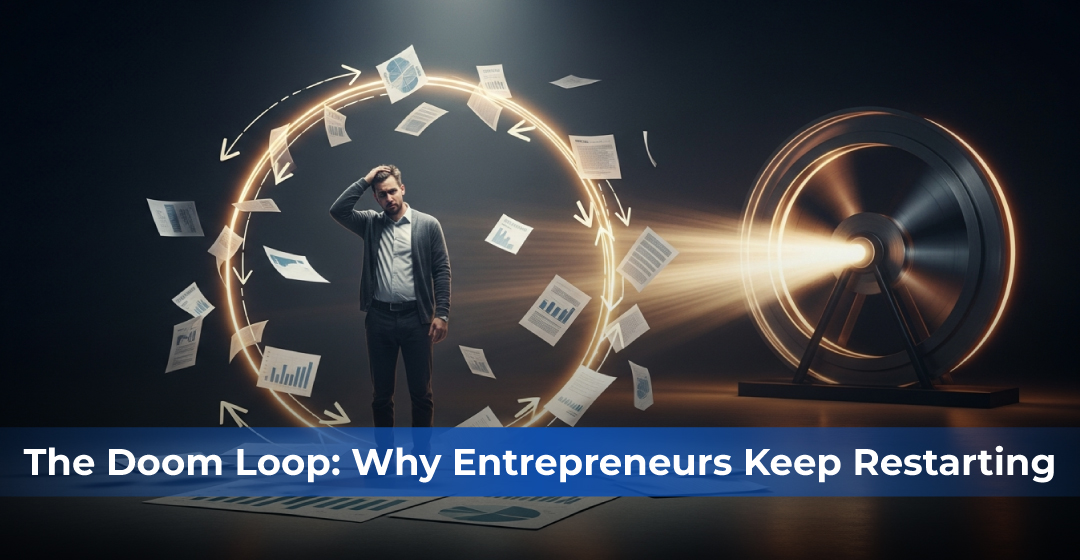





In Good to Great, Jim Collins introduces the concept of the Doom Loop. This concept is important for entrepreneurs and can be the difference between building something that lasts and constantly starting over.
What is The Doom Loop
The Doom Loop is a destructive cycle where companies go from one big idea to the next, hoping for a quick breakthrough. Instead of building steady progress, they make dramatic shifts in strategy and leadership every time results disappoint them.
What usually happens is: a company launches a new strategy with excitement. Results do not come fast enough, and they panic. They launch another new initiative or completely change direction. This new move fails to produce instant success. They change strategy again.
Each shift stops momentum before it can build. Instead of pushing a heavy flywheel consistently in one direction, the company keeps resetting it. This pattern is repeated in companies that failed to leap from good to great.
Why it Happens
The doom loop is often driven by impatience. Entrepreneurs naturally want results, and when progress feels slow, it is tempting to make a big move and rebrand. But it is important to note that great companies rarely rely on bold transformations. Instead, their success comes from disciplined and consistent efforts over time.
What This Means for Entrepreneurs
In the early stages of a business, progress can feel frustratingly slow. Revenue grows gradually, and brand awareness takes time. It is easy to feel like something big needs to change. This is why most founders fall into the Doom Loop and jump from one idea to the next. Each jump resets learning and momentum, and instead of improving what already exists, it’s abandoned for the next big idea.
What entrepreneurs should learn is that consistency does not mean stubbornly sticking to a failing idea. It means giving a well-thought-out strategy enough time to compound before deciding it does not work.
Entrepreneurs who avoid the Doom Loop tend to make thoughtful decisions rather than reactive ones and build momentum in one direction by disciplining themselves. Over time, the results begin to compound into the flywheel effect.
While big moves may feel exciting, sustainable growth is key to long-term success. For entrepreneurs building something meaningful, the challenge is not coming up with ideas, but sticking with the right ones long enough to see them work.
The Real Cost of the Doom Loop
The danger of the Doom Loop is not just wasted effort. It has lost momentum.
Every time a business changes direction prematurely, it resets learning, disrupts systems, and confuses teams. Employees lose clarity.
Customers lose consistency. Strategy loses focus.
Over time, this pattern creates instability. Instead of compounding progress, the company compounds confusion.
Entrepreneurs often believe that dramatic action shows leadership. In reality, disciplined consistency is what builds credibility. The companies that succeed are not the ones constantly reinventing themselves, but the ones refining the right strategy long enough for it to work.
Avoiding the Doom Loop requires patience, clarity, and conviction. When direction is thoughtful, and execution is steady, momentum builds. When decisions are reactive, progress stalls.
The difference between growth and stagnation is often not talent or opportunity, but discipline.
Key Takeaways
- The Doom Loop happens when businesses constantly change direction instead of building steady momentum.
- Impatience and a search for quick wins are destructive.
- Entrepreneurs who stay disciplined and consistent are more likely to engage the flywheel and build long-term success.












 Founder's Podcast
 Free Zone
 Offshore
 Mainland
 Accounting
 Banks
Banks Services
 Resources