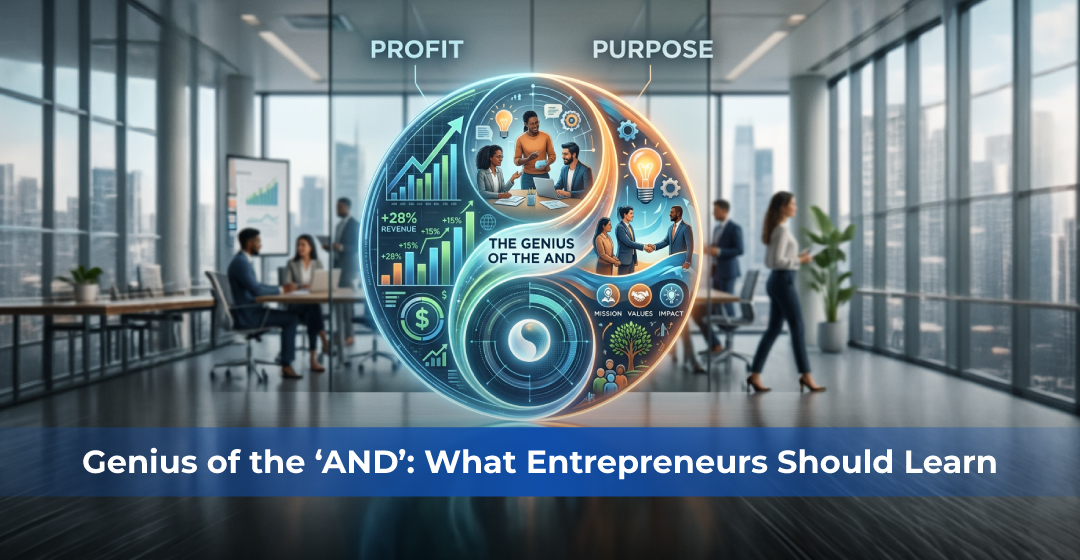






Most founders are pushed into binary choices. You either chase profit or you focus on purpose. You either keep things stable or you move fast and change everything. You either give people freedom or you tighten control. These ‘either/or’ questions feel like the sensible choice, but they trap you and restrict you over time.
In Built to Last, Jim Collins describes this trap as the ‘Tyranny of the ‘OR’’. This is the mindset that says a company must be either A or B, but not both. The alternative is what is called the ‘Genius of the ‘AND’. Great companies do not pick one route, but they build a way to hold both sides at the same time.
This is not to be confused with ‘balance’. Balance usually means meeting in the middle. Collins makes a different point. A truly great company tries to be strong in the short term AND in the long term. It aims to be idealistic AND profitable. It works to preserve a clear core identity AND also pushes hard for change and progress. The goal is not to blend two ends of the spectrum into a ‘balance’, but to keep both ends distinct and still make them work together. The yin/yang symbol demonstrates this. The authors use it to capture the idea that two forces can be different, even opposite, without cancelling each other out.
One of the clearest examples of the Genius of the ‘AND’ is the quote from George Merck II: medicine is for the patient, not for profits, and yet profits follow. Instead of making a choice between patients OR profits, both goals can be realised simultaneously. This statement does not ignore money. Instead, the point being made is that profits are necessary, but they are not the sole reason your company exists. Collins highlights that when he looked at ‘visionary’ companies, they did not run purely on profit maximisation as the main goal. They pursued a wider set of aims, and they made money while chasing those aims. Profit is described as oxygen. You need it to stay alive, but you do not wake up in the morning thinking your purpose today is to breathe. In terms of the Genius of the ‘AND’, the goal is not to balance purpose and profit, but to be highly committed to purpose and highly committed to profitability at the same time.
Why This Matters for Entrepreneurs
When you are building something early on, people push you to pick a side. You may feel pressured to pick between chasing a vision or chasing profits, letting your team have freedom or tightening control, or scaling fast or slowing down. The Genius of the ‘AND’ is a reminder that you do not have to choose one and sacrifice the other. You can do both.
This is what the Genius of the ‘AND’ may look like in practice.
- If your business is mission-led, do not treat your vision as simply a tagline. Use your purpose to decide what products to launch, which customers to focus on, and what opportunities to pursue. At the same time, ensure revenue is stable, as without a steady income, you cannot keep the mission going.
- If you want to stay creative whilst having discipline, do not assume the only way to be creative is to take risks and be messy. Add a basic structure, such as clear deadlines and responsibility so your creativity is not drowned by mess.
- If you are building a team, do not choose between being relaxed and strict. Instead, give people freedom in how they work, such as their approach and workflow, but be firm on expectations of outcome, such as results, timelines, and quality.
The key takeaway is to stop chasing between two good things and let go of the ‘either/or’ thinking. It is possible to build your company to do both purpose and profit, creativity and disciple, freedom and accountability. When you build for ‘AND’, you can achieve all your goals and have a company that is more stable and ambitious because you are not constantly swinging between extremes.












 Founder's Podcast
 Free Zone
 Offshore
 Mainland
 Accounting
 Banks
Banks Services
 Resources