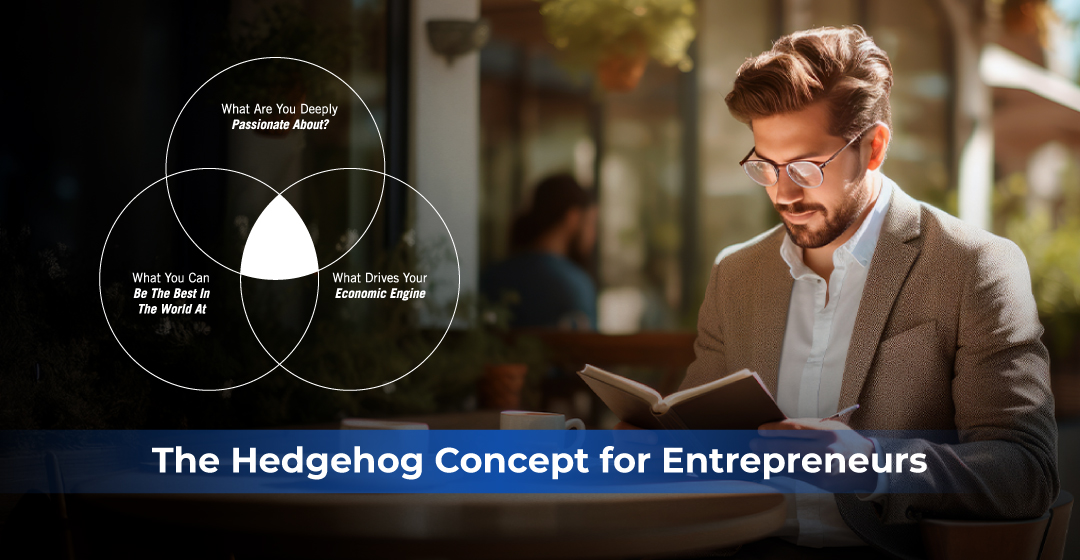






In Good to Great, Jim Collins borrows an old idea: “The fox knows many things, but the hedgehog knows one big thing.” The fox tries lots of clever moves. The hedgehog survives by doing one thing exceptionally well, every time. Collins uses this image to explain why some organisations stop chasing every opportunity and start building real momentum. They get follow-through on their “one big thing.”
Collins says the Hedgehog Concept sits at the intersection of three questions:
What are you deeply passionate about? What do you genuinely want to build?
What can you be the best in the world at? This doesn’t mean what are you decent at. It means what you could realistically become exceptional at with your resources, time, and talent. And it also implies the opposite, if you can’t be great at it, don’t build your business around it.
What drives your economic engine? Collins describes this as finding the key number that most shapes your financial results, often expressed as a single denominator such as profit per X. The point is to understand what truly drives sustainability.
Why Entrepreneurs Should Care
Most early-stage businesses don’t fail because the idea was terrible. They fail because focus slips. Founders try to do too many things at once, or they chase opportunities that look attractive in the short term but don’t add up to a sustainable business. This often happens during the business setup phase, when founders expand their scope too quickly by adding services or targeting new markets before the core business model is fully validated.
The Hedgehog Concept gives founders a way to slow down decision-making and ask better questions before saying yes. When a new idea comes up, whether it’s adding a service, targeting a different customer group, or expanding into a new market, you can test it against the three circles. Does this fit what we genuinely care about? Is it something we could realistically become exceptional at? And does it strengthen the part of the business that actually makes it viable financially?
If the answer is no, the idea is likely a distraction rather than a step forward. That discipline matters because startups operate with limited time, limited cash, and limited energy. Focus is about giving the business a fair chance to survive and grow.
How to Apply It in a Real Business
One way to approach the Hedgehog Concept is to treat it as a structured conversation rather than a checklist. Sit down with your co-founders and be honest about where the business is today.
Start by looking at your real strengths. Pay attention to what customers already value and come back for, and where you consistently deliver better outcomes than competitors.
Next, identify the single measure that best reflects your business’s health. This might be profit per customer, per project, or per transaction, depending on what you do. Understanding what truly drives sustainability makes trade-offs much easier.
Finally, be realistic about what ‘best in the world’ means for you. This does not have to be global or grand. It might apply to a narrow niche or a specific type of client. If the scope feels too broad, narrowing it is often the right move.
Using the Hedgehog Concept in Life
The same framework can be surprisingly useful outside business. Careers, like companies, often become messy when people pursue too many paths that do not really align.
In personal terms, the three circles translate into what you genuinely care about, what you can become very good at over time, and what supports a stable and fulfilling life, whether that is income, flexibility, wellbeing, or relationships.
When choices sit at the intersection of those three, progress tends to feel more intentional. You spend less energy trying to impress the wrong people or forcing yourself down paths that never quite fit.
Key Takeaways
The Hedgehog Concept helps founders and individuals filter out distractions and concentrate on the few things that truly matter, even when short-term wins seem appealing.
Progress starts with being realistic about what you care about, what you can genuinely become great at, and what actually sustains you or your business.
The same logic applies beyond business. Whether you are building a company or shaping a career, decisions made at the intersection of passion, capability, and sustainability lead to more consistent and meaningful results over time.












 Founder's Podcast
 Free Zone
 Offshore
 Mainland
 Accounting
 Banks
Banks Services
 Resources