





- What Is IFZA Tax & Compliance?
- How IFZA Corporate Tax Works
- IFZA Tax Benefits: What Tax Advantages Do Businesses Get?
- VAT Requirements for IFZA Companies
- How to Register for Corporate Tax in IFZA
- Accounting and Compliance Requirements for IFZA Companies
- Penalties for IFZA Tax and Compliance Violations
- Get Expert Support for IFZA Tax and Compliance
- Frequently Asked Questions
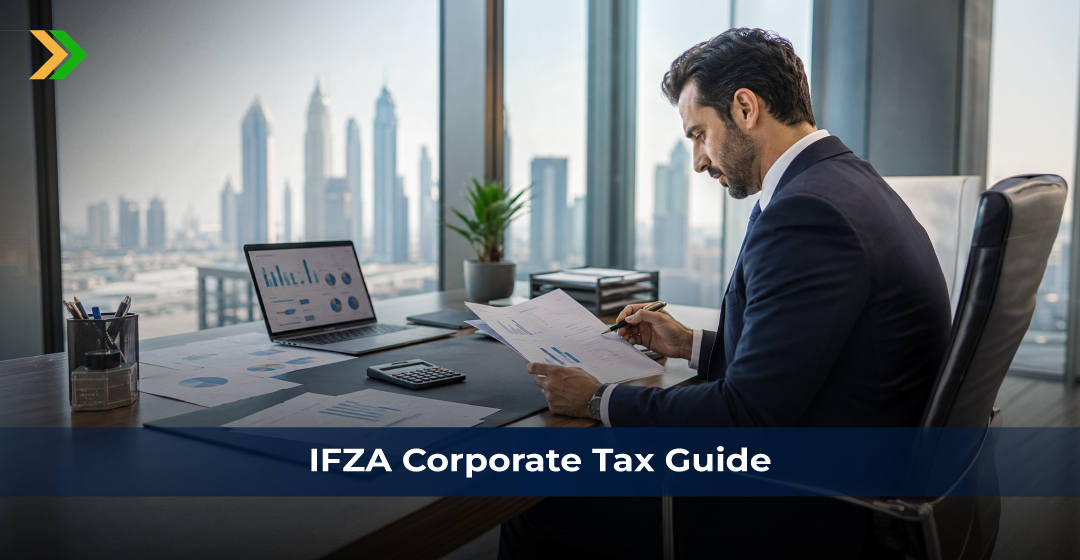
If you own an IFZA company or are planning to set one up, understanding IFZA corporate tax is no longer optional. Since the introduction of UAE corporate tax, free zone businesses must determine whether they qualify for the 0% corporate tax rate, register with the relevant authorities where required, and meet their ongoing compliance obligations.
While IFZA remains one of Dubai’s most attractive free zones, being registered there does not automatically mean your business is exempt from tax. Your obligations depend on several factors, including your business activities, the type of income you earn, and whether you qualify as a Qualifying Free Zone Person (QFZP).
In this guide, you will learn how IFZA corporate tax works, when your business may be liable to pay tax, the compliance requirements you need to meet, and the practical steps you can take to avoid costly penalties.
What Is IFZA Tax & Compliance?
IFZA corporate tax refers to the tax obligations that apply to businesses registered in the International Free Zone Authority under the UAE’s tax framework. While many entrepreneurs associate free zones with tax benefits, every IFZA business must still comply with the applicable UAE tax regulations.
Depending on your business, these obligations may include corporate tax registration, VAT, maintaining accounting records, preparing financial statements, meeting IFZA audit requirements where applicable, and complying with Anti-Money Laundering (AML) regulations.
The exact requirements vary from one company to another. For example, a consultancy with no VAT liability will have different compliance obligations from a trading company that imports goods into the UAE. Because of this, understanding your responsibilities early can help you avoid unexpected penalties later.
How IFZA Corporate Tax Works
Under the UAE corporate tax regime, businesses pay 0% corporate tax on the first AED 375,000 of taxable income and 9% on taxable income (profits). However, IFZA corporate tax works slightly differently for businesses that qualify for the Free Zone tax incentives.
If your company qualifies as a Qualifying Free Zone Person (QFZP), you may be eligible for a 0% corporate tax rate on qualifying income. To qualify, your business generally needs to:
- Maintain adequate substance in the UAE.
- Earn qualifying income under the UAE Corporate Tax Law.
- Keep non-qualifying revenue within the de minimis threshold.
- Prepare audited financial statements.
- Continue meeting the applicable corporate tax requirements.
If your business no longer meets these conditions, it may lose access to the preferential tax treatment and become subject to the standard corporate tax rules.
Because of this, setting up your business in IFZA is only the first step. To continue benefiting from the available tax incentives, you also need to ensure your company remains compliant with the ongoing requirements throughout each tax period.
IFZA Tax Benefits: What Tax Advantages Do Businesses Get?
The IFZA Free Zone offers several tax advantages that make it an attractive choice for entrepreneurs and investors. However, these benefits depend on your business meeting the relevant eligibility requirements.
Here are some of the key tax advantages available to eligible IFZA businesses:
- 0% Corporate Tax on Qualifying Income
If your company qualifies as a Qualifying Free Zone Person (QFZP), you may benefit from a 0% corporate tax rate on qualifying income. This allows eligible businesses to reduce their tax burden while remaining compliant with the UAE corporate tax regime. - No Personal Income Tax
The UAE does not impose personal income tax on individuals. This means business owners and employees do not pay tax on their personal earnings, making the UAE an attractive destination for entrepreneurs and professionals. - No Withholding Tax
The UAE currently does not levy withholding tax on domestic or cross-border payments. This can simplify international transactions for businesses operating in the IFZA Free Zone. - Access to the UAE’s Double Taxation Agreements
The UAE has signed double taxation agreements with numerous countries to help reduce the risk of the same income being taxed twice. Depending on your circumstances and the applicable treaty, your business may benefit from these agreements.
VAT Requirements for IFZA Companies
Corporate tax in Dubai and VAT are two separate obligations. Registering for one does not automatically register your business for the other, so it is important to understand when VAT applies.
If your company’s taxable supplies and imports exceed AED 375,000 over the previous 12 months, VAT registration with the Federal Tax Authority (FTA) is mandatory. However, if they exceed AED 187,500, you can choose to register voluntarily. Once registered, the standard VAT rate of 5% applies to taxable goods and services, unless a zero-rated or exempt supply applies.
If your business is registered for VAT, you will generally need to:
- Charge 5% VAT on taxable goods and services, where applicable.
- Submit VAT returns to the FTA through EmaraTax, typically on a quarterly basis.
- Keep accurate accounting records, tax invoices, and supporting documents.
- Pay any VAT due by the applicable deadline.
It is also worth noting that many IFZA companies generate export or international revenue, which may qualify for zero-rated VAT under the UAE VAT rules. However, this does not automatically remove your VAT obligations, so it is important to assess each transaction correctly.
How to Register for Corporate Tax in IFZA
If your business falls within the scope of UAE corporate tax, you must register with the Federal Tax Authority (FTA) through the EmaraTax platform. This requirement applies even if you expect to pay 0% corporate tax as a Qualifying Free Zone Person (QFZP).
The registration process typically involves the following steps:
1. Determine your registration deadline: Corporate tax registration deadlines depend on factors such as your company’s license issuance date. Registering on time is important to avoid unnecessary penalties.
2. Prepare the required documents: Before submitting your application, gather the necessary documents, including your trade license, company incorporation documents, and identification for the authorised signatory.
3. Complete your corporate tax registration: Your application is submitted through the FTA’s EmaraTax portal, where your company information and supporting documents are reviewed before approval.
4. Receive your Corporate Tax Registration Number (CTRN): Once your registration is approved, the FTA will issue your CTRN, which you will use when filing your corporate tax returns.
5. Meet your ongoing tax obligations: Registration is only the first step. You must file your corporate tax return within the applicable deadline after the end of each tax period and continue meeting your IFZA compliance obligations.
If you are unsure about your registration requirements or want to avoid costly mistakes, InZone can handle your corporate tax registration from start to finish, ensuring your application is submitted accurately and on time.
Accounting and Compliance Requirements for IFZA Companies
To remain compliant with the IFZA tax system and the UAE Corporate Tax Law, your business must maintain proper financial records, prepare financial statements, and meet any applicable audit and AML requirements.
Accounting and Bookkeeping Requirements
Every IFZA company is required to maintain proper accounting records and bookkeeping records, regardless of its size or annual revenue. These records should accurately reflect your company’s financial transactions and must be retained for at least seven years after the end of the relevant tax period. To ensure your records meet UAE requirements, many businesses rely on professional accounting and bookkeeping services in Dubai for ongoing support.
Also, your business must correctly classify its income as qualifying, non-qualifying, taxable, or exempt, depending on the nature of the transaction. This is particularly important for businesses seeking to retain Qualifying Free Zone Person (QFZP) status, as non-qualifying revenue must not exceed the lower of 5% of total revenue or AED 5 million.
Financial Statements
In addition to maintaining accounting records, IFZA companies are expected to prepare annual financial statements that present a true and fair view of the company’s financial position. These statements should be prepared in accordance with International Financial Reporting Standards (IFRS) or IFRS for SMEs, depending on the size and reporting requirements of the business.
Well-prepared financial statements support your corporate tax return, demonstrate compliance with UAE tax regulations, and provide the financial information required for audits and other regulatory obligations.
Audit Requirements
The IFZA audit requirement depends on your business and whether you qualify for certain tax benefits. Audited financial statements are mandatory for businesses with annual revenue exceeding AED 50 million, as well as for all Qualifying Free Zone Persons (QFZPs), regardless of their turnover.
Businesses that elect Small Business Relief (SBR) are generally exempt from the audit requirement. However, they must still maintain sufficient records to demonstrate that they meet the eligibility criteria. It is also important to note that Small Business Relief currently applies only to tax periods ending on or before 31 December 2026.
Anti-Money Laundering (AML) Compliance Requirements
Not every IFZA company is subject to AML compliance, but businesses operating in designated sectors must comply with the UAE’s Anti-Money Laundering regulations.
Depending on your business activity, you may need to:
- Register on the goAML platform.
- Submit your Ultimate Beneficial Owner (UBO) declaration.
- Carry out customer due diligence (CDD).
- Monitor and report suspicious transactions.
- Maintain AML policies and employee records.
Failure to meet these obligations can result in significant regulatory penalties, making AML compliance just as important as tax compliance for affected businesses.
Penalties for IFZA Tax and Compliance Violations
Businesses that fail to meet their IFZA compliance obligations may be subject to UAE corporate tax penalties imposed by the Federal Tax Authority (FTA). These penalties can apply to late registrations, missed filing deadlines, delayed tax payments, and other compliance breaches.
Some of the key penalties include:
- Late corporate tax registration: AED 10,000 administrative penalty for failing to register within the prescribed deadline.
- Late corporate tax return filing: AED 500 per month for the first 12 months, increasing to AED 1,000 per month thereafter until the return is filed.
- Late payment of corporate tax: A penalty of 14% per annum, in accordance with Cabinet Decision No. 129 of 2025 (effective from April 2026).
- Late VAT registration or VAT return filing: Penalties start from AED 1,000 for a first offence and may increase for repeated violations.
While the FTA has previously introduced temporary initiatives allowing certain businesses to apply for penalty waivers, these relief measures are subject to specific conditions and deadlines. They should not be relied upon as a substitute for meeting your corporate tax obligations on time.
Get Expert Support for IFZA Tax and Compliance
Keeping up with IFZA corporate tax and ongoing compliance requirements can be challenging, especially as your business grows. From corporate tax registration and VAT in Dubai to bookkeeping, financial reporting, and annual compliance, even a small mistake can lead to unnecessary delays or penalties.
At InZone, we help businesses stay compliant at every stage. Whether you need support with corporate tax registration, accounting and bookkeeping, VAT compliance, or understanding your obligations under the IFZA corporate tax system, our experts are here to guide you through the process.
Contact InZone today and get expert support for your IFZA business setup.










 Founder's Podcast
 Free Zone
 Offshore
 Mainland
 Accounting
 Banks
Banks Services
 Resources