

Table of Contents
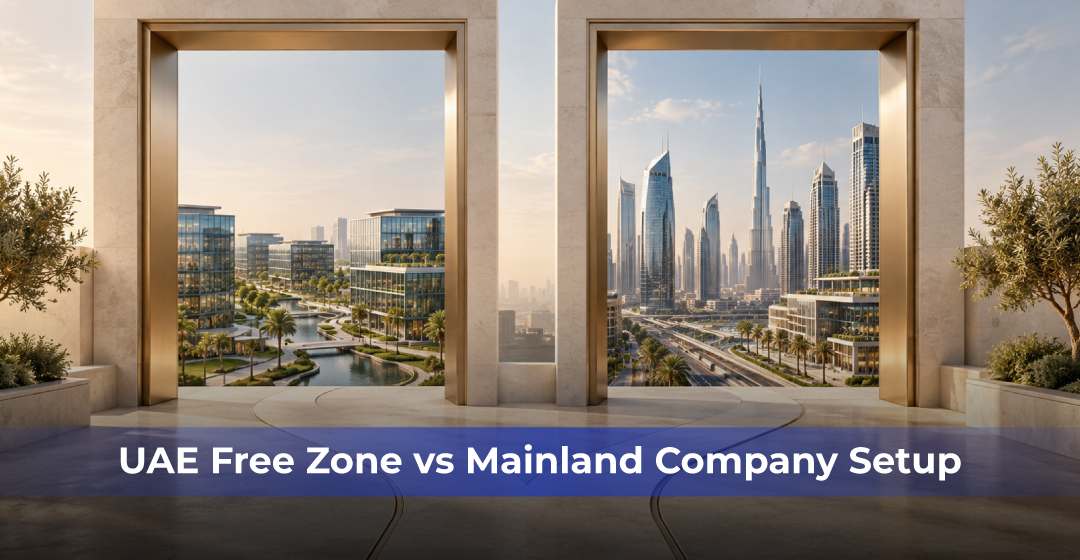
The free zone vs mainland decision depends primarily on where a business intends to trade. A free zone company offers 100% foreign ownership and a lower entry cost, but it is designed mainly for international activity. A mainland company may trade across the entire UAE market, although it requires a physical office and a larger budget.
This guide examines the difference between free zone and mainland setups in terms of ownership, office space, visas, costs, taxation, visa eligibility, and the factors to consider before registering your business.
Key Takeaways:
- The free zone vs mainland decision depends mainly on where the business trades: free zones suit international clients, while the mainland serves the UAE market directly.
- The difference between free zone and mainland setups lies in market access, office requirements, visa allocation, setup costs, and ongoing compliance obligations.
- Both structures generally allow 100% foreign ownership, although regulated or strategic activities may carry additional approval requirements.
- Free zone companies may need a mainland licence, permit, branch, or licensed distributor to trade directly in the mainland, depending on the activity and emirate.
- Free zone setups generally cost less, with Ajman Free Zone packages starting from AED 5,555.
- Both structures fall under UAE corporate tax, with 0% for Qualifying Free Zone Persons on qualifying income and 9% on mainland profits above AED 375,000.
Free Zone vs Mainland in the UAE: Key Differences
The key differences between a Free Zone and a Mainland company in the UAE come down to ownership rules, market access, business activities, office requirements, visa eligibility, setup costs, and ongoing compliance obligations.
| Factor | Free Zone | Mainland |
|---|---|---|
| Licensing authority | Independent free zone authority | Department of Economic Development (DED) of the respective emirate / Dubai Department of Economy and Tourism (DET) |
| Foreign ownership | Generally 100% | Generally 100% for most activities |
| Market access | International clients and the zone; mainland requires a permit or branch | Direct access to the UAE market |
| Business activities | Activities permitted by the selected free zone | Broad range of commercial, industrial and professional activities, with external approvals for some |
| Office space | Flexi-desk or shared space often accepted | Leased commercial space with an Ejari tenancy contract |
| Visa allocation | Depends on the free zone, package and workspace | Depends on premises, activity and approved quota |
| Setup costs | Lower entry cost | Higher overall cost |
| Corporate tax | 0% on profits up to AED 375,000, 9% above that threshold | 0% on profits up to AED 375,000, 9% above that threshold |
| Best for | Startups, international businesses and companies seeking flexible workspace options | Businesses that need direct UAE market access or operations requiring a mainland licence |
What Is a Free Zone Company in the UAE?
A free zone company is a business registered within a designated economic zone and licensed by its governing authority. The UAE Free Zones offer different business activities, licensing options, and workspace arrangements, so the right choice depends on your business activity, budget, visa requirements, and operational needs.
Key benefits include:
- Foreign ownership: Eligible investors can own 100% of their company without a local equity partner.
- Flexible workspace: Some authorities offer shared offices, flexi-desks, and other options alongside dedicated premises.
- Industry-specific support: Certain zones cater to sectors such as technology, media, logistics, finance, and trading.
- International operations: Free zone structures can suit businesses that serve clients outside the UAE.
- Capital repatriation: Investors can generally repatriate capital and profits, subject to applicable laws and obligations.
Ownership Structure:
Most free zones in Dubai permit foreign investors to own 100% of their company. The available legal structure depends on the free zone authority and the number of shareholders.
- Free Zone Establishment (FZE): Typically has one shareholder.
- Free Zone Company (FZCO or FZ-LLC): Typically has two or more shareholders.
- Branch: Allows an existing local or foreign company to establish an extension of its business.
Company structure, capital requirements, and shareholder eligibility vary by free zone, so the right option depends on the authority’s rules and your business needs.
Business Activities and Market Access:
A free zone company can carry out activities listed on its licence, subject to the relevant authority’s rules. The most common activities include consultancy, e-commerce, software development, trading, manufacturing and professional services.
Free zone companies can generally operate within their zone and serve international clients. However, conducting business directly in the UAE mainland may require an additional licence, permit or other approved arrangement, depending on the activity and emirate.
In Dubai, Executive Council Resolution No. 11 of 2025 introduced additional routes for eligible non-financial free zone companies to operate on the mainland:
- Mainland branch licence: Allows an eligible free zone company to establish a branch on the Dubai mainland.
- Free Zone Mainland Operating Permit: Allows eligible companies to operate on the mainland under a temporary permit.
Both routes require approval from the relevant free zone authority and compliance with DET requirements. The permit framework launched in October 2025.
Office Space Requirements:
Office requirements differ across UAE free zones and depend on the licensed activity, visa needs, and how the business operates.
- Flexi-desk or shared workspace: Suits consultants, online businesses, and service providers.
- Dedicated office: Suits companies with a larger team.
- Warehouse or industrial unit: Suits trading and manufacturing activities.
The workspace you choose can also affect how many visas your company is eligible for, so consider your staffing needs before selecting a package.
Visa Requirements and Eligibility:
Free zone companies can apply for eligible investor, partner, and employee visas, subject to the authority’s rules and immigration approval.
The number of visas usually depends on:
- The licence package
- The workspace type and size
- The business activity
- Other eligibility criteria set by the authority
A lower-cost package may not provide enough visas for a business planning to expand its team. Therefore, factor visa eligibility and application costs into your budget if shareholders, employees, or dependants will need UAE residence visas.
Setup Costs:
The free zone company Dubai cost depends on the authority, licence type, activity, shareholder structure, and facilities selected. Some packages bundle registration, licensing, and workspace, while others charge for these separately. A basic licence without visas often starts from approximately AED 6,000 to AED 15,000, and premium zones cost considerably more.
A complete budget should include:
- Company registration and trade licence fees
- Workspace or office rent
- Visa applications, medical tests and Emirates ID processing
- Establishment card and immigration fees
- External approvals, where applicable
- Annual licence renewal and other recurring charges
The initial licence fee is only part of the total company setup cost in the UAE. Therefore, it’s best to compare packages based on what they include and account for other ongoing expenses before making your decision.
Taxation, Banking and Compliance:
Free zone companies are subject to UAE corporate tax rules. A company must qualify as a Qualifying Free Zone Person (QFZP) and meet the conditions set by the Ministry of Finance to benefit from a 0% rate on profits up to AED 375,000, and 9% above that threshold.
Key compliance obligations include:
- Registration for corporate tax with the Federal Tax Authority (FTA), even where no tax is payable.
- Preparation of audited financial statements where QFZP status is claimed.
- VAT registration once taxable supplies exceed AED 375,000.
- Annual licence renewal.
A company that fails to meet QFZP conditions may lose the 0% rate for the current and following four tax periods. Banks also assess business activities, ownership, source of funds, and supporting documents before approving an account. Therefore, keeping accurate records and preparing the required documentation is important for both tax compliance and banking applications.
What Is a Mainland Company in the UAE?
A mainland company is licensed to operate outside the UAE’s designated free zones under the relevant emirate’s regulatory framework. In Dubai, the Department of Economy and Tourism (DET) oversees mainland business licensing within its remit. This structure suits businesses that need to serve local customers directly, work with UAE-based organisations or operate across the country.
Key benefits include:
- Direct local market access: Mainland companies can generally trade with customers and businesses across the UAE within their licensed activities.
- Business flexibility: A wide range of commercial, professional and industrial activities is available, subject to approval.
- Growth opportunities: The structure may suit companies that need physical premises, larger teams or a presence across the UAE.
- Government opportunities: Eligible businesses can pursue relevant government contracts, subject to tender and sector requirements.
Ownership Structure:
Many mainland business activities allow 100% foreign ownership in the UAE. However, certain regulated or strategic activities may have additional ownership conditions or approval requirements.
The legal structure depends on the business activity, number of shareholders, and how the company will operate. The common options include:
- Limited Liability Company (LLC): Suitable for a range of commercial and professional activities.
- Sole Establishment: Owned by one individual.
- Branch: An extension of an existing UAE or foreign company.
Business Activities and Market Access:
Mainland licences cover a wide range of commercial, professional and industrial activities, subject to the relevant licensing and approval requirements.
A mainland company can generally:
- Trade anywhere in the UAE, including with government entities.
- Bid for public and private tenders.
- Open retail outlets, showrooms and service branches.
- Obtain external approvals before starting activities that require them.
Mainland licensing therefore offers the broadest market reach for businesses that want to serve customers directly across the UAE and pursue a wider range of commercial opportunities.
Office Space Requirements:
Mainland company formation in Dubai generally involves specific premises requirements. Most businesses need a leased commercial space with an Ejari-registered tenancy contract, where applicable. The required type and size of the premises depend on the licensed activity and the company’s visa needs.
Visa Requirements and Eligibility:
Mainland companies can apply for investor and employee visas, subject to the relevant immigration requirements. Visa allocation may be affected by:
- The licensed business activity
- Office space and premises suitability
- The company’s staffing needs
- Applicable immigration quotas and other eligibility criteria
Businesses planning to hire employees should factor visa costs and office requirements into their setup budget, as visa approval is subject to the applicable rules.
Setup Costs:
The mainland company setup cost in Dubai is generally higher than a comparable free zone package because office rent, notarisation, and external approvals can add to the initial expense. A first-year budget may start at around AED 15,000 for the licence and approvals, rising to tens of thousands when office space and visas are included.
Typical cost items include:
- DET trade licence
- Initial approval and trade name reservation
- Memorandum of Association (MOA) drafting and notarisation
- Ejari-registered office lease
- Immigration card and visa fees
- Annual licence renewal
For an accurate estimate based on your business needs, speak to an InZone business setup specialist who can assess your activity, office and visa requirements.
Taxation, Banking and Compliance:
Mainland companies are subject to the UAE corporate tax regime. Key obligations include:
- Corporate tax: 0% on total profits up to AED 375,000 and 9% above that threshold.
- Registration: Registration with the FTA through EmaraTax.
- VAT: Registration once taxable supplies exceed AED 375,000.
- Records: Proper accounting records and annual licence renewal.
These requirements form part of the ongoing responsibilities of running a mainland company in the UAE.
How to Choose Between Free Zone and Mainland for Your UAE Business
The right choice between a UAE free zone and mainland company comes down to where you intend to do business, the activities you plan to carry out, and the costs you can accommodate.
A free zone may be a better fit if:
- Your clients are primarily international.
- Your activity is permitted by the selected free zone.
- You want a flexible workspace option.
- Your business model does not require unrestricted direct mainland operations.
A mainland company may be more suitable if:
- You need to serve UAE customers directly.
- Your operations require commercial premises or a physical retail location.
- You intend to pursue eligible government contracts.
- Your activity or operating model calls for a mainland licence.
Your choice should reflect your day-to-day business needs and the market you want to reach, rather than the licence cost alone.
Set Up in the Right UAE Jurisdiction with InZone
The right UAE jurisdiction depends on what your business does, who you want to serve, and how you plan to operate. InZone guides entrepreneurs through their UAE jurisdiction options, licensing requirements, and the company formation route best suited to their business.
With experience supporting businesses across the UAE, InZone can assist with:
- Jurisdiction selection: We compare relevant free zones and mainland options against your business activity and plans.
- Licence and activity guidance: We help you identify the appropriate licence type and understand any approvals your business may need.
- Company formation: Get support with registration, documentation, and the required setup procedures.
- Visa and PRO services: Understand the requirements for shareholder and employee visas, with guidance throughout the application process.
- Ongoing business support: Access accounting, tax, and other services to help meet your company’s ongoing obligations.
Speak to an InZone business setup consultant to discuss your requirements and receive guidance on the most suitable company formation options for your business.







 Founder's Podcast

 Free Zone
 Offshore
 Mainland
 Accounting
 Banks
 Services
 Resources